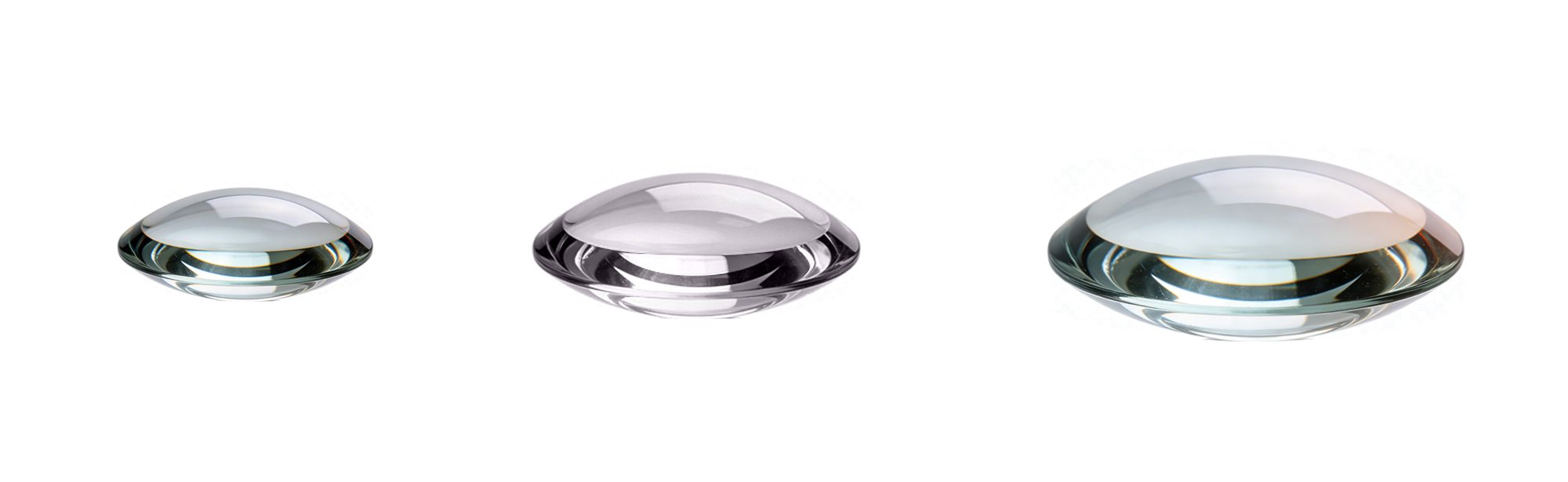
◆ Features
It adopts ultraviolet fused silica glass, which has better uniformity and a lower coefficient of expansion compared to N-BK7 glass, and is mostly used in the ultraviolet and near-infrared wavelength ranges.
Biconvex Lenses: With a positive focal length, they can be used to focus collimated light beams or collimate point light sources.
◆ Common Specifications
Material | N-BK7 |
Refractive index | 1.517 nm@587.6nm |
Surface Quality | 40-20 |
Coating | Uncoated |
Clear Aperture | ≥90% |
Center Deviation | ≤3′ |
◆ Applications
Ultra-Low-Light Imaging
Laser Energy Delivery
Industrial Inspection
Wide-Temperature Equipment
Dimensional requirements: Determine the outer diameter and thickness according to the spatial layout of the optical system and the beam size.
Mounting compatibility: All circular lenses from MLOPTIC can be mounted on MLOPTIC standard lens sleeves, fixed lens mounts and various coaxial mounting plates. Customers can choose the optimal mounting method for different application scenarios.
Cleaning taboos: Do not use acidic/alkaline solvents for cleaning. It is recommended to gently wipe with anhydrous ethanol and lint-free swabs.
Coating Considerations:Uncoated lenses exhibit ~90% transmittance due to Fresnel reflections at both air-glass interfaces.
The spherical aberration of a biconvex lens is larger than that of a plano-convex lens, and sometimes the focal spot cannot converge to a single point.


Material | N-BK7 | Clear Aperture | ≥90% CA |
Diameter | Φ50.8 mm | Diameter Tolerance | 0.0/-0.1mm |
Center thickness | 25.36 mm | Thickness tolerance | ±0.1 mm |
Edge thickness | 3.0 mm | Radius of curvature | 34.442 mm |
Wavelength Range | 0.3-4μm | Refractive index | 1.5168@587.6nm |
Focal length | 38.1 mm | Focal Length Tolerance | ±1% |
Back focal length | 28.54 mm | Coating | Uncoated |
Center Deviation | ≤3′ | Surface Quality | 40/20 |
Surface flatness | 1.5λ@633nm | F-number | 0.7 |




 Double-Convex(DCX) Lenses

